Saturday, June 13, 2009

Lcd Tv Connecting To A External Hard Drive

ELEMENTS OF A CASH FLOW EXAMPLE

elements that are part of a flow of funds are basically the following: income, investment costs, operation and maintenance and salvage values. So there are other elements that can affect the flow of funds from a project, such as depreciation, depletion of intangible assets and depletion of natural resources.
1.
income revenues are included in cash flow are obtained through the sale or rental of goods or services of the project. Must be recorded in the year they expect to receive, regardless of when they are incurred.

It should be noted that revenue in the cash flow of the project should include both operating income (whether from the sale of the finished product or service delivery) and financial income (for example, for investment of reserves).

It is possible that some projects do not generate any income, do not produce any products or services tradable. Also create projects that simply change the way of producing a particular good or service, without changing the income received from its sale. The financial evaluation of these projects is still important for two reasons: first, to fill out a detailed profile of costs so that you can develop an investment plan and financing, and 2 to compare project costs with other alternatives to ensure that is done in the most efficient way possible, that is most convenient for the investor.

2.
costs

Project costs are usually classified into two broad categories: investment costs and operating costs. For purposes of proper preparation of cash flow will be necessary to study the handling should be given to the dead and the costs of opportunity costs.

2.1 The investment costs
The first major category of costs that should be included in the assessment of a project are those of investment or production of it.
investment costs generally consist of outlays for the acquisition of nominal assets or assets and working capital financing. Acquisition costs Fixed assets represent disbursements for the purchase of land and buildings: the payment of civil works, and purchase of equipment, machinery and works of installation or support. Costs for nominal assets are investments in intangible assets, but needed to make the project work: patenting and licensing, technology transfers and technical assistance costs of formation and organization, and also the costs of training and training.

Finally, investments in working capital reflects the funds must be committed to achieving short-term assets and inputs for the production cycle, necessary for the operation of project. Within this area are basically cash and inventories (both inputs and raw materials and final product). We must distinguish between stock and working capital requirements and investment in working capital (or change in stock) that is what is recorded in the cash flow and cost. This reversal or at least a part of it is retrieved later (at the end of the life of the project), recorded in the flow with a positive sign, as income.

investment costs are not deductible taxes directly. These costs are not deducted when they are paid and are not recorded in the flow of funds and securities tax deductible. Is depreciation deduction that allows asset values \u200b\u200bnet taxable income annually, but in periods after the investment outlay.

2.2 The Operating Costs

The second major category of cost is for operating costs, consisting of payments for inputs and other items necessary for the production cycle of the project over its operation.

These costs can be classified as production costs, sales, administrative and financial. These, in turn, can be disaggregated, inter alia, labor costs, raw materials and supplies, leases and rentals and financial costs and taxes.
Operating costs are recorded in the period of the respective disbursements occur (cash accounting).

In any evaluation, it is necessary to distinguish between operating costs that are deductible from income tax and not deductible. Where most of them are deductible, any cost that is not register with the flow of funds in a manner different from other costs.

Generally, the estimated project cost also includes a category for "incidental."

2.3 The Costs Dead

is important not make the mistake of including dead cost on the flow of funds. These costs are defined as already done, which are inescapable, regardless of the investment decision is taken.

In other words, they are unavoidable costs, but decided not to make the project being evaluated. Such as proposing a bill that would increase the productivity of agricultural land, it engages a multidisciplinary team to design the project. They propose two possible projects and charge $ 100,000 for his advice. The proposed project costs include labor, equipment procurement, civil works and operating costs. These are avoidable costs and which are not paid if not done the project. In contrast, the $ 100,000 paid for professional advice represent an unavoidable cost, or cost dead, that in no way change the fact that professionals charge for their work, ie the cost of the advice has to be paid. As a result, should not be recorded as cost of the project.

costs is clear that death should not be included in the cash flow of a project. However, these can influence the flow, to the extent that the depreciation of fixed assets, natural resource depletion and amortization of intangible assets affecting the payment of taxes for a project, for this reason, it is indispensable establish the carrying cost of the items considered dead at the beginning of the life of the project and determine the amount of depreciation, depletion or amortization thereof, and applicable taxes. However, always essential to ensure that you compare the situation with project and without project, giving only the differences.

2.4 The Opportunity Cost

The opportunity cost is defined as the value or profit generated by a resource in its best alternative use. If the opportunity cost of an input used by the project is different from its acquisition price, then cash flow should be assessed according to the first.

's often presents an opportunity cost when the input used by the project is not acquired solely for him and have alternative uses.

Thursday, June 11, 2009

Names Of Parts Insidethe Car


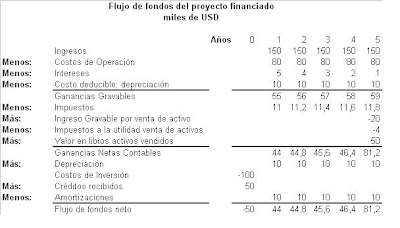
A project will be done in a country where there is no inflation. Requires a total investment of $ 100 million: half for depreciable assets and the other for non-depreciable assets.
investment is made in period 0. The life of the project has an implementation period of five years and depreciable assets have no salvage value. The loss on sale of other assets, which amounts to $ 20 million, will be charged to last period.

investment is financed at a 50% equity and 50% with a loan. This $ 50 million loan is amortized in five equal installments of $ 10 million each from the period 1.

The interest rate on this loan is 10% annual percentage yield on balances past due. Sales are $ 150 million per year and operating expenses excluding financial expenses and depreciation are $ 80 million per year.

rate income tax is 20%.
Depreciation is performed on 100% of the acquisition value of depreciable assets over a period of five years, with the method linear.

PROBLEM SOLUTION

Cashflow without funding, that is pure flow of a project without funding:


Funds flow financing, ie flow of a project funded:
BIBLIOGRAPHY

1. Nassir Sapag Chain, Reinaldo Sapag Chain, "Preparation and Evaluation", Fourth Edition.

2. Ernesto R. Fontaine, "Social Evaluation of Projects", 12 th Edition

3. Karen Marie Mokate, "Financial Evaluation of Investment Projects", First Edition.

Pirates Of The Caribbean Theme Guitar Chords

CASH FLOW CASH FLOW TYPES OF MARKET STRUCTURE

There are two types of cash flows: the flow of the project without funding (also called the flow of the "pure") and the flow financing (also known as flux or flow of the project financed by the investor).

In the flow of the project without funding, it is assumed that the investment required for the project funding comes from internal sources (own), ie that the total resources needed from the project executing agency or the investor.

funded in the flow, it is assumed that the resources used by the project are in part owned and part of third persons (natural or legal) ie that the project uses external resources for funding.

PROJECT PURE FLOW

flow recorded in the taxable income including income from sales, services and investments of temporary excess cash. Of this income, deductible expenses are subtracted, which are operating, maintenance, management, marketing, sales, excise taxes, and depreciation. Upon completion of this process gives the net taxable income, which is the basis for the calculation of taxes attributable to the project.

The result of subtracting the taxable net direct taxes add the gain from the sale of assets, income taxes take extraordinary and non-deductible costs and add non-taxable income (sale of assets by book value and subsidies, mainly) could be called the "net."

This net income, depreciation must be added, since it represents a cash disbursement of the project and subtract the costs of investment (fixed assets and nominal, pre expenses - operating and working capital). We also have to adjust for other costs not deductible or taxable income. This is the end-result: the flow of funds from the project (without funding).

FUNDED PROJECT FLOW

This flow differs from the earlier to the extent that they consider the sources of project financing. Therefore, revenues are recorded by the receipt of principal on loans and credits (income is not taxable, being an account of the Balance Sheet). Also include the costs of debt servicing in the flow: the interest and fees are deductible operating costs and depreciation are not deductible disbursements.

BASIC OUTLINE OF A CASH FLOW
CASH FLOW AND INVESTMENT DECISIONS

As described, the cash flows used in the financial evaluation of projects to synthesize the data generated in studies that are part of the formulation and preparation of a project.

However, we must not forget that this whole procedure is followed in order to summarize this information in a selection criterion.

From this point of view, the information recorded in the flow must be studied in order to reflect the positive and negative impacts that are actually attributable to the project and which had not been incurred if the project been carried out. That is why the decision whether or not a project takes only with regard to so-called "incremental cash flow."

This flow is formed only from the revenues and costs attributable to the project, which is where it had not been incurred if the project had not executed.

REFERENCES 1. Nassir Sapag Chain, Reinaldo Sapag Chain, "Preparation and Evaluation", Fourth Edition
2. Ernesto R. Fontaine, "Social Evaluation of Projects", 12 th Edition
3. Karen Marie Mokate, "Financial Evaluation of Investment Projects", First Edition.

Thursday, May 14, 2009

Tnf Treatment For Ankylosing Spondilitis


Know which is shaping the market structure for your product in a project ......

By: Monica Thompson Mrs. Jannette B.


The competitive environment that will occur in the project, if implemented, can acquire one of the following forms of market: From the point of view of the number of applicants, most popular markets are monopsonistic and oligopsony. The termination "sone" indicates that we are referring to the next buyer in the market, "mono" is one and "oligo" there are a few. From the point of view of bidders, economic theory identifies four basic market types: perfect competition, monopoly, oligopoly and monopolistic competition. This allows us to analyze and predict how operators will behave in each of them. These market structures are defined by four characteristics.
  • number of producers in the market.
  • either type (homogeneous or differentiated). Grade
  • price control by the company.
  • existence of barriers to entry.

Market Structure

Perfect competition is characterized by that there are many buyers and sellers of a product, by their size, can not influence prices, the product is identical and homogenous there perfect resource mobility, and economic actors are fully informed of market conditions.

Distinguishing features of perfect competition are:

  1. coexist many vendors and applicants who are willing to buy or sell a particular product.
  2. products offered in this market are homogeneous or equal, ie there is no difference in the product that is offered by all companies.
  3. Buyers and sellers have no control distinguishable on the selling price, ie no influence on the market price is set so impersonal in the market.
  4. Buyers and sellers are well informed that this type of market information flows perfectly.
  5. The efertantes or sellers do not spend much time developing a marketing strategy, or its related activities.
  6. Buyers and sellers can freely sell or buy them so they have freedom of movement (in or out).
  7. Under the conditions reported, vendors companies have horizontal demand curve (or perfectly elastic).

monopoly exists when a single supplier sells a product for which no substitutes, and difficulties in entering the industry are great.
The three characteristics of a monopolistic market are the following:

  1. The market is composed of a single vendor.
  2. The seller only sells a product that has no similar substitute.
  3. Barriers to entry are high. This means it is very difficult to enter the market.

Thus, the monopolist has concentrated all the force of a given sector, a group of consumers who are forced to consume their product no matter what conditions this imposes to trade with them and for them. With which consumers see their power restricted to the conditions set by the monopolist.

The near monopoly has no competition because there are barriers to entry by other producers of the same product. These barriers can be of different types (legal barriers, technological or otherwise), and become potential obstacles that new producers can not pass.

Monopolistic competition is characterized by numerous sellers of a differentiated product and because in the long run there is no difficulty entering or exiting the industry.

Monopolistic competition is defined as the market organization in which there are many companies that sell merchandise similar but not identical. Because this product differentiation, the sellers have some degree of control over the prices they charge.

However, the existence of many close substitutes significantly limits the power of "monopoly" of vendors and results in a very elastic demand curve.

In this type of competition, there is a significant number of producers operating in the market without a control dominant part of any of these in particular.

The key issue here is that it presents a product differentiation, ie a particular product, depending on the producer, may have variations that allow it to be, in some respects, different from other similar products made by other companies.

A oligopolistic market structure exists when there are few sellers of a homogeneous or differentiated product and enter or exit the industry is possible, albeit with difficulty.

The conditions for the submission of an oligopoly, and that also distinguishes it from other models could be:

  • Competitors maintain close communication, either directly or indirectly.
  • There are no restrictions to competitors wishing to participate in the market segment, we can only indirectly restrict the entry of these new competitors.
  • oligopolistic competitors can reach substantial agreements, whether direct or indirect.
  • The competition is not as closed as other models such as monopolistic competition.

Resources page:

  1. Nassir Sapag Chain, Reinaldo Sapag Chain, "Preparation and Evaluation Project ", Fourth Edition
  2. http://www.promonegocios.net/mercado/competencia-perfecta.html
  3. http://www.liccom.edu.uy/bedelia/cursos/economia/archivos / STRUCTURES DE
  4. MERCADO.pdf
  5. http://www.monografias.com/trabajos15/tipos-mercado/tipos-mercado.shtml